


In 2025, Polkadot OpenGov went through a deliberate phase of consolidation.
A total of 482 proposals entered voting this year — more than 50% fewer than in 2024. But fewer proposals didn’t mean lower quality. In fact, the average DOT per proposal jumped 50% in November, monthly unique voters stayed stable, and participation clearly spiked during major decisions. When it really mattered, voters showed up.
This year also saw a historic decision to set a supply cap for DOT, while the Treasury continued funding infrastructure and ecosystem. Another major proposal Referendum #1827 is live, signaling another upcoming change to staking mechanics.
Every major upgrade on Polkadot is decided on-chain through OpenGov, with the community actively shaping each critical moment.
The next step for governance is simple — bring more holders into the process. That’s exactly what Bifrost’s vDOT Delegation Voting unlocks: a way for liquid staked DOT holders to finally activate their governance power and participate in OpenGov more easily.
vDOT: The First Liquid Staking Token with Native Governance Right
Unlike most liquid staking tokens, vDOT preserved DOT’s governance rights from day one.
If you hold vDOT, you can already vote directly in Polkadot OpenGov through the Bifrost Dapp — yield, liquidity, and governance are fully integrated.
Now, with delegation voting live, governance becomes even more accessible. If you don’t have time to research every proposal, you can simply delegate your voting power to someone you trust and stay involved without extra effort.
Governance and Staking Yield, Working Together
vDOT delegation follows Polkadot’s native Delegation Voting model, with some important upgrades on Bifrost.
Same delegation mechanics as DOT
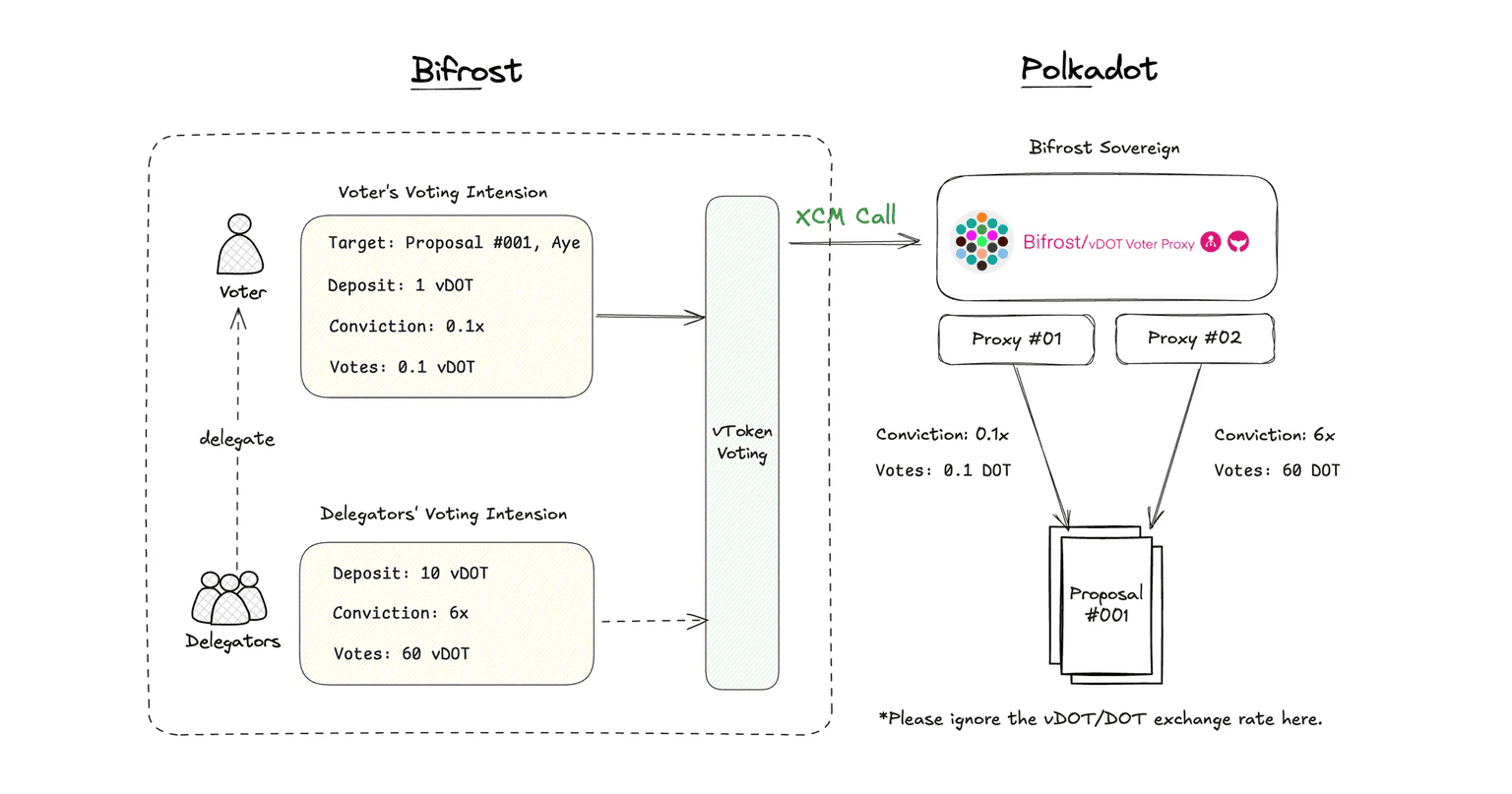
You can delegate your vDOT to any address with a conviction multiplier from 0.1x to 6x. Your voting power scales based on the multiplier you choose.
Let’s walk through a simple example:
- Bob delegates 10 vDOT to Alice with 6x conviction (224-day lock).
- Alice votes on a proposal using 1 vDOT at 0.1x conviction, voting AYE.
- Bob’s delegated 10 vDOT automatically follows Alice’s vote with 6x weight, contributing 60 votes in the same direction.
During the voting period, Bob can cancel the delegation at any time and regain control immediately.
If Bob cancels after voting ends, he’ll need to wait until the 224-day lock expires to unlock.
In the current version, delegation applies to all governance tracks by default. Future upgrades will support track-specific delegation, letting users assign different delegates for different topics.
| Feature | DOT Delegation | vDOT Delegation | | --- | --- | --- | | Delegate to any address | ✅ | ✅ | | Conviction (0.1x–6x) | ✅ | ✅ | | Track selection | ✅ | Default: All tracks | | Cancel anytime | ✅ | ✅ |
BNC-powered governance delegation
vDOT also introduces something new: BNC-driven governance via the vDOT Delegation Track (DVT).
Users can delegate their vDOT directly to Bifrost OpenGov’s DVT, a dedicated governance track that aggregates all delegated vDOT voting power.
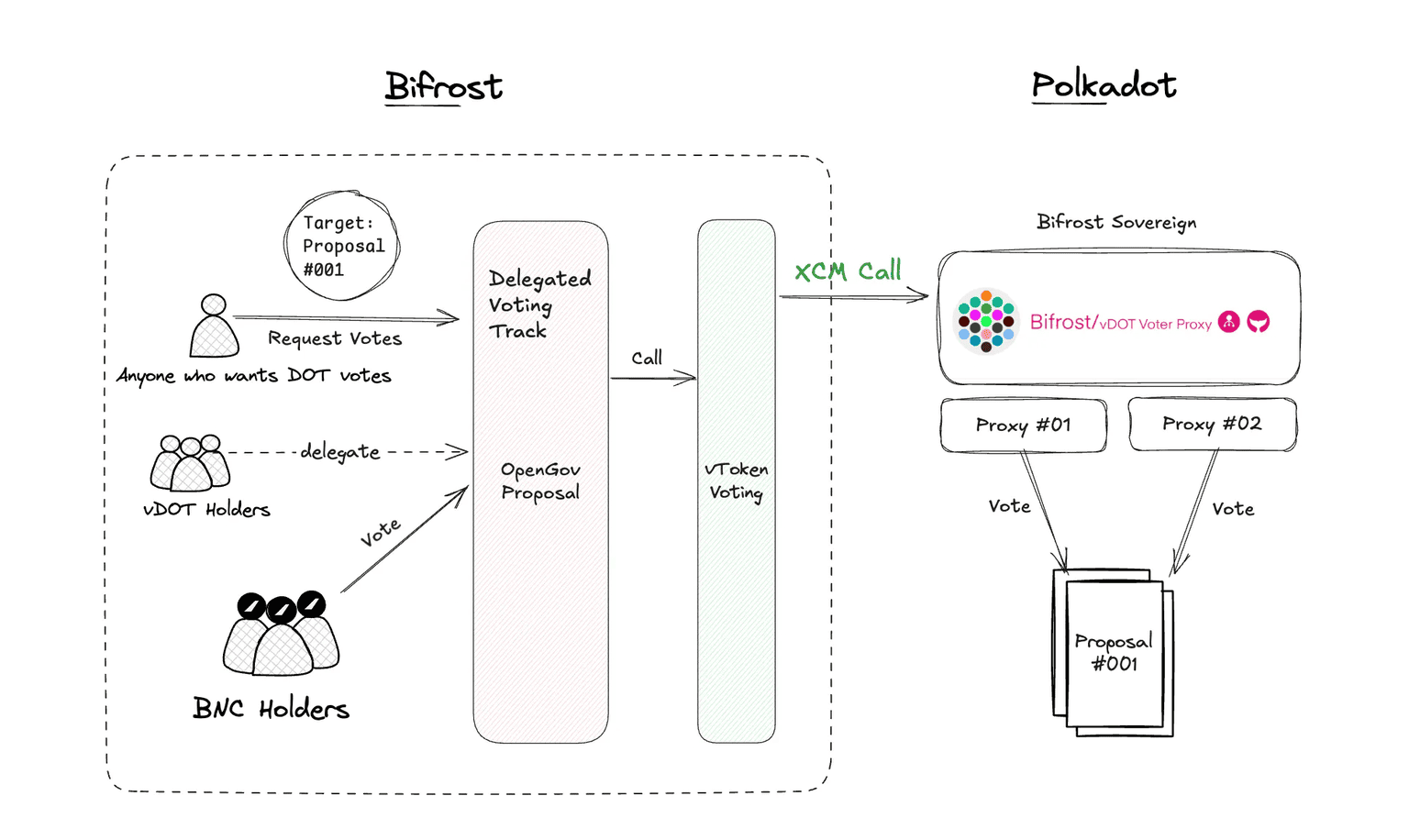
On DVT, BNC holders vote to decide how the pooled vDOT votes are cast, creating a cross-asset governance loop where BNC helps steer DOT governance. This effectively links BNC and vDOT inside the governance system and opens up new utility for BNC.
Why This Matters
Delegation brings new energy into the governance ecosystem. Today, many vDOT holders are already active in DeFi protocols like Hydration while also participating in OpenGov — playing both capital and governance roles.
Users naturally fall into two groups:
- DeFi-focused users who want capital efficiency but don’t have time to track governance.
- Governance-focused users who understand proposals and are willing to act as representatives.
Delegation voting lets DeFi users stay involved without friction, while active participants can build reputation and become trusted voters over time.
Most importantly, delegation voting never transfers asset ownership.
Whether you delegate to another address or to Bifrost DVT, your vDOT always stays in your own wallet, and you can revoke delegation anytime.
If your delegated vDOT participates in a vote, it will follow the chosen conviction lock.
If you don’t delegate, your liquidity and redemption flow remain unchanged.
This gives users full flexibility to balance governance participation and capital control.
Expanding BNC Utility
vDOT delegation also reflects a broader goal: lowering the barrier to governance participation.
Healthy governance depends on whether users can participate with low cognitive cost. Delegation makes participation easier while allowing governance to evolve toward more structured and accountable representation.
At the same time, the DVT model brings BNC directly into the governance engine, creating a shared voting pathway with vDOT and expanding BNC’s long-term utility and narrative.
vDOT Delegation FAQ
How do I delegate my vDOT?
- Go to Bifrost Dapp
- Open vDOT → Governance
- Click Delegate Voting
- Enter a delegate address or select DVT
- Choose your conviction multiplier (0.1x–6x)
- Sign and confirm
What’s the difference between Capital and Vote?
- Capital: the amount of tokens you hold
- Vote: your effective voting power = Capital × Conviction
Why delegate to Bifrost OpenGov (DVT)?
DVT represents the Bifrost community when voting on Polkadot governance proposals.
If you’d like your vDOT voting power to be decided collectively by the Bifrost community, DVT is a great option.
What happens if someone delegates to me?
Any delegated voting power automatically follows your votes.
If 10 vDOT are delegated to your address, those votes will follow the same direction and conviction when you vote.
Can I cancel delegation?
Yes — you can cancel anytime.
- If voting is still ongoing, you can unlock immediately by updating your vTokenVoting action.
- If voting has ended, you’ll need to wait for the conviction lock to expire.